Alice (Xia) Zhu, M.Sc., Ph.D.
Environmental & Marine Scientist | Plastic Pollution Researcher | Environmental Champion
Current and Past Projects
Greenhouse gas emissions from plastic degradation and plastic waste management activities (2025-present)
Plastic pollution and its waste management activities constitute a potentially significant yet overlooked source of greenhouse gas emissions. Without a complete understanding of this source, we risk introducing uncertainty into Earth's remaining carbon budget. Recognizing this, I co-authored a perspective on the state of knowledge of greenhouse gas emissions from the photodegradation of plastic pollution in the environment. In addition, I am currently collaborating with National Research Council (NRC) Canada to measure greenhouse gas emissions from the open burning of plastic waste, a prevalent form of waste management deployed across the globe.
Perspective: Royer and Zhu (2026)

Adapted from Royer and Zhu (2026)
The Impact of Plastic Pollution on the Biological Carbon Pump (2024-present)
I am sampling the "sinking pool" of microplastics in the North Atlantic Ocean and Gulf of Mexico using deep sediment traps in conjunction with colleagues from Memorial University of Newfoundland (Canada), National Oceanography Centre (UK), and the Leibniz-Institute for Baltic Sea Research (Germany). My aim is to better understand how quickly plastic moves between the ocean surface and deep ocean reservoirs (the "settling flux"). In tandem, I am elucidating the impact of microplastics on the biological carbon pump by generating artificial marine snow in the lab using a cold-water diatom, Thalassiosira gravida, and measuring the impact of microplastics on aggregate properties.

Are microplastics biogeochemically relevant in the ETNP Oxygen Minimum Zone? (2023-present)
I am interested in investigating whether microplastics have permeated the biogeochemically relevant OMZ region of the eastern tropical North Pacific (ETNP), and what their potential effects are. Samples of the ETNP ocean water column were obtained on a UC Ship Funds Student Cruise March 9-20, 2023 at Scripps Institution of Oceanography, La Jolla, USA onboard the R/V Sally Ride. I trained a student to process and quantify microplastic particles from these samples, and am collaborating with colleagues from the University of California, Merced to interpret these results.

The Plastics & Climate Project (2023-2025)
I conducted a systematic review to determine the knowns and unknowns in our understanding of how plastics impact climate as part of an initiative I co-founded called The Plastics & Climate Project. The outcomes of this two-year project included a peer-reviewed journal article, summary report, and convening in Washington D.C. to help disseminate knowledge on the interconnections between plastics and climate to governments and the public. This project was carried out in conjunction with Monterey Bay Aquarium, World Resources Institute, Environmental Law Institute, and GRID-Arendal.
Systematic review: Zhu et al. (2025)
Plastic is part of carbon cycle, Front. Mar. Sci.: Zhu (2021)
Editorial in The Conversation: Zhu (2021)

Global Reservoirs of Plastic Pollution in the Marine Environment (2017-present)
I am quantifying major resting places or reservoirs of plastic pollution in the marine environment to help constrain the global marine plastic budget. I use a combination of statistical and mathematical modelling approaches in my work. Reservoirs of interest include global coastlines, the ocean floor, and marine animals. This project is in conjunction with colleagues from Scripps Institution of Oceanography, Rochester Institute of Technology, and Sea Education Association in the US, and the Commonwealth Scientific and Industrial Research Organisation in Australia.
Framework for the Global Plastic Cycle: Zhu (2021)
The ocean floor reservoir: Zhu et al. (2024)
The marine animals reservoir: Zhu et al. (2025) and The Conversation piece
Synthesis piece: Comparison of inventories of plastic in different global marine reservoirs, Zhu et al. (2026)

Plastic Spiraling in River Networks (2021-2025)
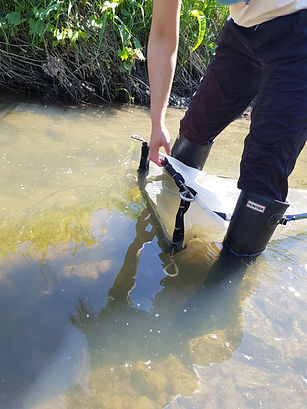
Together with colleagues from Loyola University Chicago, the University of Toronto, and the University of New Hampshire, I am investigating how plastic is transported through watersheds and what factors (storm intensity, imperviousness) affect its movement. We have sampled microplastic and macroplastic from various habitats in three temperate watersheds across North America (Don River, North Branch Chicago River, and Ipswich River). We found that stormflow plays a major role in mobilizing plastic in rivers and that the composition of microplastics in the water column shifts from fibre- to rubber-dominated during higher flows.
NSF Grant Start Date: 10/01/2021, Awarded Amount: $418,107
The influence of flow on riverine plastic: Haney et al. (2025)
Storms influence plastic transport: Schwenk et al. (2025)
Watershed land use predicts anthropogenic litter: Hoellein et al. (2026)
Emissions Inventories of Plastic Pollution (2020-2024)
Akin to emissions inventories of greenhouse gases, I proposed novel a framework for measuring emissions of plastic pollution that can be applied to any city, province/state, or country around the world. This accounting tool can help make the Global Plastics Treaty more quantitative - by helping to inform effective mitigation, measure baseline emissions, set emission reduction targets, and track progress towards reaching targets. My work is currently helping to inform a national toolkit for measuring plastic emissions being developed by the United Nations Environment Programme.
Viewpoint about concept in ES&T: Zhu and Rochman (2022)
Framework and case study of Toronto in ES&T: Zhu et al. (2024)

Sources and Fate of Microplastic and Other Anthropogenic Microdebris in San Francisco Bay, California, USA (2017-2021)
I helped lead an ecosystem-wide study of plastic pollution in San Francisco Bay in collaboration with San Francisco Estuary Institute, 5 Gyres Institute, and the University of Toronto. My team and I analyzed 300+ samples of sediment, fish, and water for microplastics and reported our findings to help inform policies to mitigate microplastic inputs into the Bay. Throughout this multi-year project, numerous studies were published that helped to advance knowledge of sources and sinks, sampling and analysis protocols, and mitigation strategies in the field of plastic pollution including:
Summary paper of our findings: Zhu et al. (2021)
Raingardens mitigate microplastic inputs: Gilbreath et al. (2019)
Stormflow is a major pathway for microplastics and tire dust: Werbowski et al. (2021)
Recommendations for sampling surface water: Hung et al. (2010)
A novel microfiber identification method: Zhu et al. (2019)
Microplastics in SF Bay summary report: Sutton et al. (2019)
